Why Is LinkedIn Premium So Expensive?
Why is linkedin premium so expensive? It’s a question many professionals ask when they see the subscription price for the first time. LinkedIn offers an excellent platform for networking, job searching, and building business relationships, but its Premium membership can feel surprisingly costly compared with other online subscriptions.
For job seekers, freelancers, entrepreneurs, and business professionals, the decision isn’t always straightforward. Premium promises advanced networking tools, additional profile insights, learning resources, and better ways to connect with people outside your existing network. Yet paying a substantial monthly fee can seem difficult to justify, especially when LinkedIn already provides many useful features for free.
The answer comes down to how LinkedIn positions its paid services. Instead of offering entertainment or general productivity tools, LinkedIn sells access to features designed to support professional opportunities. The company targets people and businesses that may associate a successful connection, job offer, or client relationship with significant financial value.
Still, that doesn’t mean everyone needs a paid subscription.
In this guide, we’ll examine LinkedIn Premium pricing, the reasons behind its high cost, what subscribers receive, and how to find affordable membership options. We’ll also explore whether upgrading makes financial sense and how to avoid spending money on features you rarely use.
Understanding LinkedIn Premium and Its Pricing Structure
LinkedIn Premium is a collection of paid subscription services designed for different professional needs. Unlike LinkedIn’s free membership, these plans provide additional capabilities for career development, business networking, prospecting, and recruitment.
Premium Career focuses primarily on employment opportunities and professional growth. Premium Business provides broader networking and business-oriented features. LinkedIn also offers specialized products, including Sales Navigator and Recruiter Lite, for users with more demanding professional workflows.
Each subscription targets a different audience, which explains why prices vary considerably.
How Much Does LinkedIn Premium Cost in 2026?
LinkedIn’s published US starting prices provide a useful comparison.
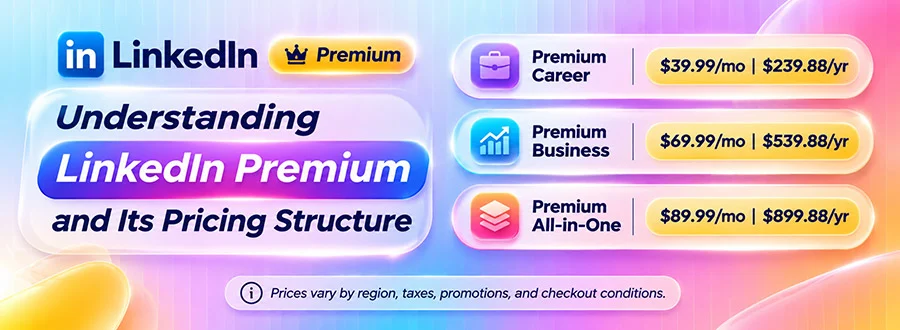
| LinkedIn Subscription | Starting Monthly Price | Starting Annual Price |
| Premium Career | $39.99 | $239.88 |
| Premium Business | $69.99 | $539.88 |
| Premium All-in-One | $89.99 | $899.88 |
| Premium Company Page Essentials | $99.99 | $839.88 |
These are published starting prices for individual subscriptions or licenses, not guaranteed prices in every region. Local currency, taxes, promotional offers, and checkout conditions can affect the final amount.
Specialized products such as Sales Navigator and Recruiter Lite have separate pricing, which should be checked directly with LinkedIn.
Why Annual Pricing Looks More Attractive
Annual subscriptions generally offer a lower effective monthly cost than paying month by month.
For example, Premium Career costs $239.88 annually at the published US starting rate, equivalent to $19.99 per month. Choosing monthly billing at $39.99 would cost $479.88 over twelve months.
That’s a meaningful difference for someone who expects to use the service consistently.
However, annual billing involves a larger upfront payment and is less flexible when your professional circumstances change.
A lower monthly equivalent doesn’t necessarily make an annual subscription the better financial decision.
Why Is LinkedIn Premium So Expensive Compared to Other Subscriptions?
To understand why is linkedin premium so expensive, it’s important to consider what LinkedIn believes its customers are purchasing.
The platform isn’t simply charging for extra buttons or a more attractive profile. It packages professional information, networking capabilities, and specialized tools into subscription products aimed at users seeking career or business results.
Several factors contribute to its premium positioning.
1. LinkedIn Targets Professionals With High-Value Goals
Most entertainment subscriptions compete for users’ leisure time. LinkedIn Premium targets goals that may influence income, employment, and business growth.
A person searching for a higher-paying position might consider additional job insights valuable. A consultant attempting to reach company decision-makers may see advanced messaging capabilities as an investment.
Because these outcomes can potentially be financially significant, LinkedIn can position its tools at higher subscription prices.
That positioning doesn’t prove the service delivers those results. It explains why its pricing differs from general consumer applications.
2. Access to Professional Networks Has Commercial Value
LinkedIn provides a large professional network containing recruiters, executives, specialists, founders, and potential business contacts.
Premium features can make discovering and approaching relevant people more convenient.
For example, InMail allows eligible subscribers to message certain members outside their direct connections, subject to plan limits and messaging rules.
This capability may be valuable when a relevant contact is difficult to reach through ordinary connections.
However, access to someone’s profile doesn’t guarantee a conversation, reply, interview, or business transaction.
3. Advanced Insights Require Additional Platform Features
Premium subscribers receive access to selected insights beyond those available with free accounts.
These may include expanded information about profile visitors, job applicant comparisons, company research, and other plan-specific tools.
LinkedIn uses these differences to distinguish paid memberships from its basic service.
While individual features might appear modest, the combined package creates a subscription aimed at frequent professional users.
Whether that package is worth the price depends on how often you actually use the information.
4. Different Professionals Have Different Willingness to Pay
A student applying for an internship and an established business consultant may place very different values on networking tools.
The student might use LinkedIn occasionally, while the consultant could rely on it for regular client development.
LinkedIn addresses these different needs through multiple subscription tiers.
Higher-priced plans typically target users with broader networking requirements or specialized business objectives.
This structure allows the platform to charge different amounts for different categories of professional functionality.
5. Premium Includes More Than Networking
Another reason behind the subscription price is access to multiple services under one membership.
Premium Career includes LinkedIn Learning, job-related tools, profile insights, and a monthly allocation of InMail messages.
Premium Business adds capabilities designed around professional visibility and business relationships.
For subscribers who use several features regularly, this combined approach may be convenient.
For users interested in only one feature, however, the package can feel unnecessarily expensive.
What Are You Actually Paying For With LinkedIn Premium?
Before searching for the cheapest linkedin premium plan, it helps to understand which features might genuinely improve your experience.
Not every plan includes identical benefits, and some tools are more useful for particular professional goals.
Advanced Job Search Features
Premium Career provides additional features designed to support job discovery and application decisions.
Depending on availability, subscribers can access job match insights, applicant comparisons, profile improvement suggestions, and other employment-related tools.
These resources may help candidates prioritize applications and understand how their profiles align with particular opportunities.
They don’t replace a strong resume, relevant experience, or effective interview preparation.
InMail Messaging Credits
InMail lets subscribers contact certain LinkedIn members without requiring an existing first-degree connection.
LinkedIn currently lists five monthly InMail credits for Premium Career and up to fifteen for Premium Business.
This feature may be useful for carefully targeted recruiter outreach or business introductions.
Sending generic messages to large numbers of people, however, is unlikely to produce meaningful results merely because the messages are paid.
Expanded Profile Viewer Information
LinkedIn Premium offers enhanced information about people who have visited your profile, subject to privacy settings.
For freelancers and job seekers, this can reveal possible professional interest and suggest opportunities for follow-up.
Not every visitor can be identified, particularly when someone uses private viewing mode.
Profile views should therefore be treated as signals rather than proof of serious interest.
LinkedIn Learning Courses
LinkedIn Learning provides professional training across subjects such as leadership, software development, marketing, communication, and business management.
This can be useful when you have clear learning objectives and regularly complete relevant courses.
However, watching courses without applying the knowledge may deliver limited practical value.
The strongest results come from combining learning with projects, experience, and measurable skill development.
Business Research and Networking Tools
Premium Business includes additional capabilities for discovering professionals and understanding companies.
These features can support entrepreneurs, consultants, and people responsible for building commercial relationships.
Nevertheless, Premium Business isn’t the same as Sales Navigator, which provides a more specialized sales prospecting environment.
Choosing the correct product is essential because paying for tools you don’t require can make the overall investment unnecessarily costly.
What Is the Cheapest LinkedIn Premium Plan?
For most individual job seekers, Premium Career is the cheapest linkedin premium plan among LinkedIn’s main personal Premium Career and Business subscriptions.
It provides employment-related features without the higher cost associated with business-oriented memberships.
However, the best option depends on your goals, expected usage, and available discounts.
Premium Career: Best for Job Seekers
Premium Career is generally the most accessible choice for people seeking employment or professional development.
Its features help users explore opportunities, contact relevant professionals, and develop skills.
When considering why is linkedin premium so expensive, remember that Premium Career combines several tools into one package.
An annual subscription can offer significant savings compared with twelve individual monthly payments.
Nevertheless, paying annually only makes sense when you expect to use Premium over an extended period.
Premium Duo: Best for Two Professionals
LinkedIn also offers Duo subscription options for eligible Premium Career and Premium Business memberships.
Duo allows two people to maintain independent accounts while sharing a single subscription payment arrangement.
For eligible users, this can make linkedin premium cheap on a per-person basis compared with purchasing two separate monthly subscriptions.
Both participants must meet LinkedIn’s eligibility requirements, and availability can vary by account and region.
Before purchasing, compare Duo pricing against individual annual subscriptions, since the best value depends on the billing cycle.
Free LinkedIn: Best for Occasional Users
Free LinkedIn remains a practical option for professionals who mainly update their profiles, connect with colleagues, and apply for jobs.
You can still create a professional presence and develop meaningful relationships without paying for Premium.
Sometimes, the cheapest linkedin premium plan isn’t necessary because the free membership already supports your primary objectives.
How to Get LinkedIn Premium Cheap Without Taking Risks
Understanding why is linkedin premium so expensive often leads users to search for discounts and alternative purchasing methods.
Fortunately, several legitimate approaches can reduce subscription expenses without putting your account at risk.
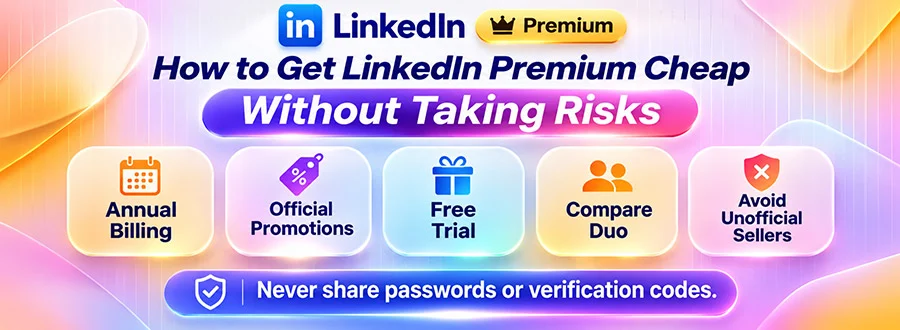
1. Choose Annual Billing When Appropriate
Annual billing can substantially reduce the effective monthly price.
Before committing, calculate how much you would spend on monthly payments over the period you realistically expect to use Premium.
For short job searches, a flexible monthly subscription might still be more economical.
2. Look for Official Promotional Offers
LinkedIn sometimes provides introductory promotions or account-specific offers.
Check your Premium subscription page to see whether any discounts are available.
If you’re looking for linkedin premium cheap offers, prioritize promotions displayed directly by LinkedIn rather than unverified third-party websites.
Avoid assuming that discounts advertised to other users will automatically apply to your account.
3. Consider a Free Trial
Eligible users may receive a free trial when exploring LinkedIn Premium.
A trial provides an opportunity to evaluate features before committing to ongoing payments.
However, eligibility is not guaranteed, and trial subscriptions typically renew automatically unless canceled.
Review the renewal date and payment conditions carefully.
4. Compare Duo and Individual Memberships
Two professionals interested in the same Premium tier should examine Duo pricing.
An eligible Duo arrangement may lower the combined subscription cost.
For people comparing options for the cheapest linkedin premium plan, it’s important to evaluate the total payment rather than the advertised savings percentage alone.
5. Avoid Unofficial Account Sellers
Some websites advertise unusually inexpensive Premium memberships.
These offers may involve unauthorized access, questionable payment arrangements, or subscription methods that violate platform requirements.
A legitimate linkedin premium cheap subscription should come through LinkedIn or an authorized promotional arrangement.
Never provide your password, verification codes, or sensitive account information to an unknown subscription seller.
LinkedIn Premium vs Free: Which One Is Better?
The comparison between free and paid LinkedIn depends on how frequently you need advanced professional tools.
| Feature | Free LinkedIn | LinkedIn Premium |
| Professional profile | Yes | Yes |
| Job applications | Yes | Yes |
| Basic networking | Yes | Yes |
| InMail credits | Not included as a standard benefit | Included with eligible plans |
| Expanded profile insights | Limited | Available |
| LinkedIn Learning access | Limited or separate access | Included with eligible plans |
| Advanced job insights | Limited | Plan-dependent |
| Subscription cost | Free | Paid |
For occasional users, free LinkedIn can be enough.
For people actively searching for employment, building professional relationships, or conducting business research, additional features may provide value.
The question why is linkedin premium so expensive becomes less important when you can clearly identify how the membership supports your goals.
Nevertheless, paying for Premium doesn’t automatically make your profile more attractive to recruiters or guarantee better opportunities.
Is LinkedIn Premium Worth the Money?
Determining whether Premium is worthwhile requires comparing the subscription cost with its practical benefits.
For Students and Recent Graduates
Students may find Premium Career helpful when preparing for internships, researching employers, and exploring professional development courses.
However, graduates with limited budgets should first optimize their profiles and use free job search resources.
Even the cheapest linkedin premium plan can become an unnecessary expense when advanced features go unused.
For Active Job Seekers
People applying for jobs regularly may benefit from additional applicant insights, recruiter outreach, and learning opportunities.
A focused subscription during an active search can be more economical than maintaining continuous access.
If you’re wondering why is linkedin premium so expensive, evaluate whether the paid tools are improving your application strategy rather than measuring value by the number of features offered.
For Freelancers and Entrepreneurs
Freelancers and entrepreneurs might benefit from expanded networking and business discovery capabilities.
Reaching one suitable client could potentially justify several months of subscription expenses.
However, potential revenue shouldn’t be mistaken for guaranteed results.
Professionals seeking linkedin premium cheap options should consider whether Premium Career provides enough functionality before upgrading to a more expensive business plan.
For Established Professionals
Experienced professionals with strong networks may not need Premium continuously.
If your existing connections already provide introductions, referrals, and professional opportunities, the free platform might be sufficient.
Premium becomes more attractive when you have specific networking or learning objectives that require additional features.
How to Calculate the Real Value of LinkedIn Premium
A practical method for evaluating Premium is to measure how the subscription influences your professional activities.
Start by establishing a clear objective, such as contacting ten relevant hiring managers, completing two courses, or researching a defined group of companies.
Next, track the results over a month.
Did your outreach generate useful conversations? Did the learning resources improve your skills? Did advanced insights help you prioritize worthwhile opportunities?
When investigating why is linkedin premium so expensive, this approach is more meaningful than comparing subscription prices alone.
You should also consider the time saved through additional tools.
If Premium helps you identify relevant contacts faster, the convenience may be valuable even without an immediate financial return.
However, if you rarely open the platform, the subscription is unlikely to justify its price.
Common Mistakes That Make LinkedIn Premium Feel Overpriced
Users sometimes purchase Premium expecting immediate improvements in their careers.
Unfortunately, advanced features cannot compensate for an incomplete profile, irrelevant applications, or ineffective outreach.
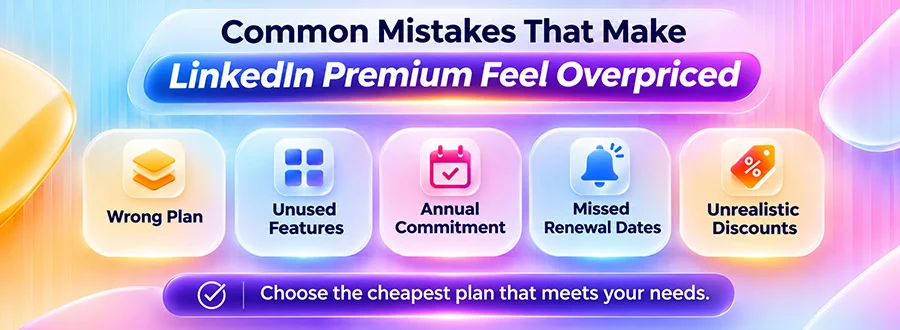
Another mistake involves selecting a more expensive membership than necessary.
For example, a person primarily interested in job applications may not need Premium Business.
Choosing the cheapest linkedin premium plan that genuinely meets your requirements is usually more sensible than paying for capabilities you won’t use.
Subscribing annually without assessing future usage can also create unnecessary spending.
Finally, overlooking renewal dates may result in charges after a trial or promotional period ends.
Users searching for linkedin premium cheap alternatives should focus on legitimate savings and thoughtful subscription management rather than unrealistic offers.
Frequently Asked Questions
Why Is LinkedIn Premium So Expensive for Job Seekers?
The reason people ask why is linkedin premium so expensive is that the platform charges for specialized career tools instead of basic social networking.
Premium Career combines job-related insights, InMail, learning resources, and additional professional information.
Whether these justify the cost depends on individual usage and career goals.
Can I Get LinkedIn Premium for Less Money?
Yes. Annual billing, eligible promotional offers, free trials, and Duo subscriptions may help reduce costs.
For many individual job seekers, Premium Career remains the cheapest linkedin premium plan within the main personal Premium options.
Always review the current price before subscribing.
Is There a Cheap LinkedIn Premium Subscription for Students?
LinkedIn may provide eligible users with trials or promotional offers, but a permanent student discount should not be assumed.
Students searching for linkedin premium cheap memberships should check official offers and evaluate free alternatives before purchasing.
Is LinkedIn Premium Worth It for One Month?
It can be worthwhile during an intensive job search or a clearly defined professional development project.
One month offers an opportunity to explore paid features without making a long-term financial commitment.
However, outcomes depend on how actively and effectively you use the service.
Does LinkedIn Premium Guarantee a Job?
No. Premium can support job searching through additional tools, but it cannot guarantee interviews, employment, or recruiter responses.
Your qualifications, professional presentation, applications, and market conditions remain important.
Can I Cancel LinkedIn Premium Anytime?
LinkedIn generally allows subscribers to cancel Premium, with access continuing until the end of the applicable paid billing period.
Cancellation methods depend on where the subscription was purchased.
Review LinkedIn’s official cancellation and refund policies for details.
Is Paying Annually Better Than Paying Monthly?
Annual billing usually offers a lower effective monthly price.
However, monthly billing provides greater flexibility when you only need Premium temporarily.
The cheapest linkedin premium plan for your circumstances depends on the total amount you’ll actually spend.
Why Do Some People Pay More for LinkedIn Premium?
Subscription costs vary because LinkedIn offers different membership tiers, billing cycles, and regional prices.
Some professionals purchase specialized products for sales or recruitment rather than standard Premium Career.
Therefore, the price someone else pays may not represent the amount available to your account.
Final Verdict: Should You Pay for LinkedIn Premium?
So, why is linkedin premium so expensive when so many LinkedIn features are available for free?
The main reason is its positioning as a professional development and business networking service. LinkedIn charges for additional information, messaging capabilities, learning resources, and tools that may support valuable career opportunities.
However, higher pricing doesn’t automatically translate into better results.
For job seekers, Premium Career may provide sufficient features at a lower cost than other major personal Premium plans. Professionals with broader business needs can evaluate additional subscription tiers.
If affordability is your priority, compare annual billing, promotional offers, and eligible Duo memberships. Avoid unauthorized sellers promising unrealistic discounts.
Ultimately, finding linkedin premium cheap options matters less than choosing a membership you’ll actually use.
A free LinkedIn account combined with a strong professional profile and consistent networking can outperform an expensive subscription that’s barely used.
Choose Premium when its features solve a specific problem, support a measurable objective, and fit comfortably within your budget.