
LinkedIn Premium Business Plan: Is It Right for You?
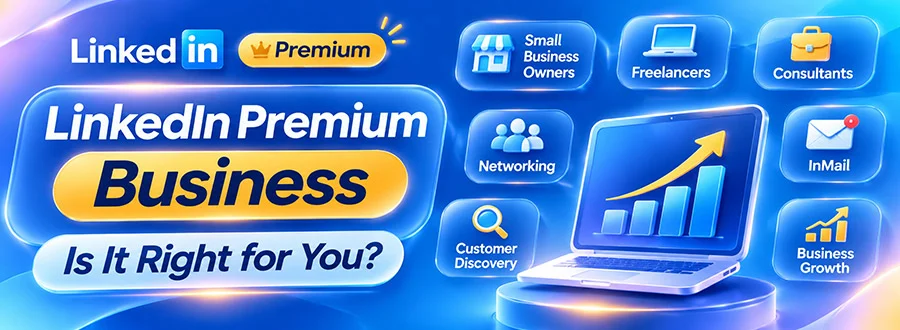
linkedin premium business is designed for entrepreneurs, consultants, freelancers, business owners, and professionals who want to expand their networks, discover new business opportunities, and build stronger professional relationships. Unlike career-focused subscriptions, this membership concentrates on business growth, professional visibility, prospecting, and communication.
But is it really worth paying for?
If you already use LinkedIn to connect with potential customers, research competitors, communicate with decision-makers, or promote your services, you may have wondered whether upgrading could make those activities more effective.
The answer depends on how you use the platform and what you expect from the additional features. Some tools can be genuinely useful for professionals who regularly conduct business research and outreach. Others may provide limited value if you primarily use LinkedIn to publish occasional updates or maintain existing connections.
In this detailed review, we will explore the features, pricing, benefits, limitations, free trial, and alternatives. We will also compare different LinkedIn subscriptions to help you decide whether the investment makes sense for your business.
Whether you run a small agency, operate as an independent consultant, manage a growing company, or work in business development, this guide will help you make an informed decision.
1. What Is LinkedIn Premium Business?
LinkedIn Premium Business is a paid subscription designed for professionals and small business leaders who want to build credibility, expand their reach, and grow their professional networks.
It provides additional tools that go beyond the standard LinkedIn experience.
A free account already allows you to create a professional profile, connect with people, publish content, follow companies, and communicate with your existing connections.
The paid membership adds capabilities that can make professional research, networking, and customer discovery more convenient.
For example, imagine that you run a digital marketing agency and want to connect with business owners in the United States.
You can use LinkedIn to identify potential clients, research their companies, understand their professional backgrounds, and explore opportunities for collaboration.
Additional search filters, profile information, and InMail messaging can make this process more structured.
1.1 Who Is This Subscription Designed For?
The membership is particularly relevant to:
- Small business owners looking for customers.
- Freelancers searching for new clients.
- Marketing agencies developing B2B relationships.
- Independent consultants building professional credibility.
- Entrepreneurs researching competitors and markets.
- Business development professionals.
- Professionals expanding their industry networks.
- Consultants looking for strategic partnerships.
It is also relevant to people who want to build their personal brand while growing a business.
However, the subscription is not essential for every professional. Someone who uses LinkedIn primarily for occasional networking may find that a free account provides everything they need.
1.2 How Is It Different From a Regular LinkedIn Account?
The main difference is the amount of information and communication flexibility available.
With a standard account, you can connect with people and use basic professional search tools.
A paid membership provides additional profile-view information, advanced search capabilities, InMail credits, business insights, and access to professional learning resources.
These features are particularly valuable when you have a clear business objective.
For instance, if you regularly research potential clients, being able to explore professional profiles beyond your immediate network can make your research more efficient.
However, the subscription does not automatically generate leads, guarantee replies, or produce new customers.
Its value depends on how effectively you use the available tools.
2. LinkedIn Premium Business Features Explained
Understanding the actual features is essential before deciding whether to purchase a subscription.
The most useful tools are those that help you discover relevant professionals, understand businesses, and develop meaningful relationships.
According to LinkedIn’s official plan information, the membership includes several business-oriented capabilities.
2.1 Unlimited Profile Viewing Beyond Your Network
One of the most useful features is the ability to view profiles beyond your immediate professional network.
With a free account, certain profile-viewing and search limitations may affect how extensively you can research people.
The paid membership provides unlimited access to view profiles beyond your immediate network, subject to LinkedIn’s applicable platform and privacy rules.
This can be helpful when researching:
- Potential customers.
- Business owners.
- Industry leaders.
- Company executives.
- Recruitment professionals.
- Potential business partners.
- Decision-makers.
For example, suppose you provide website development services and want to approach businesses that need website improvements.
You can research company representatives, understand their professional backgrounds, and identify relevant people before starting a conversation.
This makes networking more targeted.
However, viewing a profile does not automatically create a business relationship. Your communication and the relevance of your offer still matter.
2.2 Advanced Search Filters
Finding the right people is often more difficult than finding a large number of people.
Basic searches can return many profiles that are unrelated to your business objectives.
Advanced search filters help narrow down the results and identify more relevant professionals and companies.
Depending on the available filters, you can refine searches using professional and company-related criteria.
For example, a marketing consultant looking for clients might want to research:
- Founders of small businesses.
- Marketing directors.
- Company owners.
- Professionals in a specific industry.
- Decision-makers in selected organizations.
The objective should be to identify people who are genuinely relevant to your services.
A smaller, well-researched prospect list is usually more useful than thousands of random profiles.
2.3 InMail Messaging
InMail is one of the most recognizable paid networking features.
It allows eligible members to send messages to people outside their immediate professional network without first becoming connected.
This can be useful when you want to introduce your services to a potential customer or contact someone responsible for a business decision.
For example, a freelance SEO consultant may discover a company owner who is actively expanding their online business.
Instead of waiting for a connection request to be accepted, the consultant can use an available InMail credit to introduce their services.
A good message should:
- Mention the recipient’s business.
- Explain why you are contacting them.
- Identify a relevant business challenge.
- Introduce your experience briefly.
- Suggest a useful next step.
Avoid generic messages that simply promote your company.
Professional communication should create a reason for the recipient to respond.
2.4 Company Growth Insights
Business information can help professionals understand the organizations they want to approach.
LinkedIn Premium Business provides business insights that include company growth trends and hiring activity.
These details may help you identify organizations that are expanding or changing their operations.
For example, a software development agency might research companies showing signs of growth.
An organization expanding its team could potentially need additional technology, recruitment, marketing, or operational support.
However, hiring activity should not be treated as proof that a company needs your services.
Use company information as a starting point for research rather than assuming that every growing business is a qualified prospect.
2.5 Profile Visitor Information
Understanding who visits your professional profile can help you evaluate whether your networking activities are reaching the right audience.
The membership provides visibility into people who viewed your profile over the past 90 days, subject to viewer privacy settings.
For a business owner, this information may reveal whether potential customers, partners, or industry professionals are discovering their profile.
Imagine that you recently published an article about website optimization.
After publication, you notice visitors from marketing agencies and technology companies.
That information may suggest that your content is attracting attention from relevant industries.
However, a profile view does not necessarily indicate buying interest.
Some visitors may be researching your background, while others may simply have discovered your profile through a discussion or search.
2.6 LinkedIn Learning Access
Professional development is another important part of the membership.
LinkedIn provides access to more than 25,000 LinkedIn Learning courses through its Premium Business offering.
These courses cover areas such as:
- Business strategy.
- Leadership.
- Sales and marketing.
- Project management.
- Data analysis.
- Communication.
- Technology.
- Productivity.
- Entrepreneurship.
For example, a small business owner may want to improve their understanding of sales management or digital marketing.
A consultant might explore courses about negotiation, communication, and client relationships.
The courses can provide structured learning opportunities, but completing them does not automatically make someone an expert.
The greatest benefit comes from applying the knowledge to real business situations.
2.7 Profile Optimization Recommendations
LinkedIn also provides personalized tips designed to help improve profile visibility and engagement.
A professional profile is often one of the first places potential customers visit after discovering a service provider.
Your profile should clearly explain:
- What you do.
- Who you help.
- Which problems you solve.
- What experience you have.
- How people can contact you.
For example, a vague headline such as “Business Owner” communicates very little.
A more informative headline could be:
“Digital Marketing Consultant | SEO Strategy | Helping Businesses Grow Organic Visibility”
This makes your professional positioning easier to understand.
Profile recommendations can support improvement, but you should always ensure that your descriptions accurately represent your experience.
3. LinkedIn Premium Business Price: How Much Does It Cost?
Pricing is one of the most important factors when evaluating a professional subscription.
LinkedIn uses different prices depending on location, billing frequency, subscription options, taxes, and promotional availability.
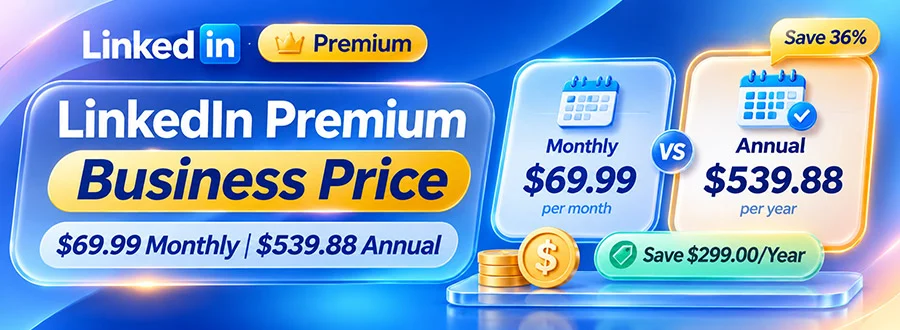
According to LinkedIn’s official pricing page, the starting US price is:
| Billing option | US starting price |
| Monthly subscription | $69.99 |
| Annual subscription | $539.88 |
| Effective monthly annual cost | $44.99 |
The annual option provides approximately 36% savings compared with paying the monthly price for twelve months.
These figures are published starting prices and may exclude applicable taxes or promotional discounts.
3.1 Localized Pricing
LinkedIn also publishes starting prices in several other currencies.
| Country or region | Monthly | Annual |
| United States | $69.99 | $539.88 |
| United Kingdom | £49.99 | £359.88 |
| Canada | C$74.99 | C$599.88 |
| Australia | A$74.99 | A$599.89 |
| Euro pricing | €52.49 | €407.88 |
Prices may vary depending on the billing platform and applicable taxes.
If you are purchasing from Bangladesh, check the final amount shown in your account rather than relying on US pricing.
3.2 Is Annual Billing Better?
Annual billing is cheaper on an effective monthly basis.
However, that does not automatically make it the best choice.
Consider a consultant who only needs additional prospecting tools for a short business campaign.
Paying for a full year may be unnecessary if the tools will only be used for a few months.
On the other hand, a business owner who regularly researches customers and develops professional relationships may find annual billing more economical.
The correct choice depends on how frequently you use the features and whether the cost is justified by your business activities.
3.3 What Should You Consider Before Paying?
Before purchasing, consider:
- How frequently do you use LinkedIn for business development?
- Do you need to contact professionals outside your network?
- Do you regularly research companies and decision-makers?
- Will the additional insights improve your sales or networking process?
- Can you comfortably afford the recurring expense?
The answers will help you determine whether the subscription deserves a place in your operating budget.
4. LinkedIn Premium Business Free Trial: How to Get It
If you are interested in exploring the additional features without immediately paying, LinkedIn may offer an eligible free trial.
This gives you an opportunity to evaluate the subscription before making a longer-term commitment.
However, not every member qualifies, and the trial duration can vary depending on promotional conditions and regional availability.
4.1 Eligibility Requirements
LinkedIn’s official trial guidance identifies several important conditions.
- Not all accounts qualify.
- Previous trial usage may affect eligibility.
- A valid credit card is required.
- Trial duration can vary.
- Switching between different Premium plans during a trial is not allowed without losing the original trial benefits.
- Automatic billing begins when the trial ends unless cancelled beforehand.
You should check the actual offer displayed in your account.
4.2 How to Activate the Trial
Follow these steps:
Step 1: Visit LinkedIn and sign in.
Step 2: Click your profile picture or Me icon.
Step 3: Select Settings & Privacy.
Step 4: Open Account preferences.
Step 5: Find Subscriptions & payments.
Step 6: Click Upgrade for Free if the offer is available.
Step 7: Select the business membership.
Step 8: Review the trial duration and billing information.
Step 9: Enter your required payment details.
Step 10: Confirm the activation.
After activation, check the subscription management page for the next billing date.
4.3 How to Avoid an Unexpected Charge
A free trial automatically converts into a paid subscription unless cancelled before the deadline.
LinkedIn recommends cancelling at least one day before the next scheduled billing date to avoid another charge.
If you cancel a free trial, Premium access ends immediately.
Therefore, record the trial expiration date and decide how long you need to evaluate the features.
Do not depend entirely on email reminders, particularly if you purchase through a mobile device.
5. What Is the Duo Option?
One interesting option is the Duo subscription.
This allows two people to receive separate individual memberships under one shared subscription arrangement.
It may be useful for:
- Business partners.
- Co-founders.
- Consultants working together.
- Two colleagues managing business development.
- Small professional teams.
According to LinkedIn’s published US starting prices, the Duo option costs:
| Billing option | Duo starting price |
| Monthly | $118.98 |
| Annual | $917.98 |
These amounts are for the combined Duo subscription, not the price of a single individual licence.
The Duo option can be attractive when two people independently need the membership features.
For example, two business partners may use their separate professional profiles to develop relationships with different customer groups.
One person could focus on potential clients while the other researches partnerships and industry opportunities.
However, it is not a replacement for a full team-wide enterprise solution.
Each person should evaluate whether they will use the individual membership sufficiently to justify the combined cost.
6. Who Should Choose This Plan?
The usefulness of the subscription depends heavily on your professional role.
Some professionals can benefit from the additional networking and research tools, while others may not need them.
6.1 Small Business Owners
Small business owners often need to develop relationships with customers, suppliers, and potential partners.
The additional search and profile information can support their research activities.
For example, a business owner operating a consulting company may use LinkedIn to identify decision-makers in their target industry.
The subscription can make this process more organized.
6.2 Freelancers
Freelancers often depend on professional relationships and referrals to find new clients.
A designer, developer, copywriter, or marketing consultant may use LinkedIn to identify businesses that match their services.
InMail can provide another communication channel when a potential client is not already connected.
However, a well-written portfolio and a relevant service offer remain essential.
6.3 Digital Marketing Agencies
Marketing agencies can use LinkedIn to research businesses, identify decision-makers, and develop professional relationships.
For example, an SEO agency may focus on companies with outdated websites or limited search visibility.
Company insights and professional research can help identify organizations worth approaching.
The subscription does not replace lead qualification, sales strategy, or campaign management.
6.4 Independent Consultants
Consultants often sell expertise rather than physical products.
Building credibility and demonstrating professional knowledge are therefore important.
Additional profile insights and learning resources can support their professional development.
However, consultants should focus on publishing useful content and demonstrating their experience rather than relying entirely on paid visibility tools.
6.5 Entrepreneurs
Entrepreneurs can use professional networking to explore partnerships, identify industry trends, and research potential markets.
The subscription may help organize these activities.
It is particularly relevant when the founder regularly uses LinkedIn as part of a structured business development strategy.
7. LinkedIn Premium Business vs Premium Career
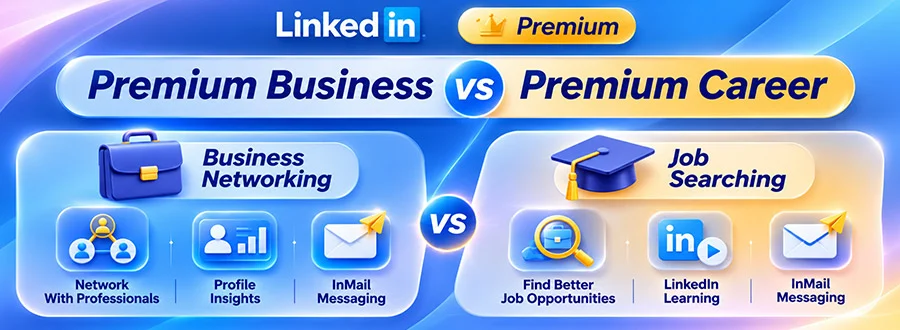
Choosing the correct membership is important because LinkedIn offers different subscriptions for different professional objectives.
Premium Career focuses on employment and job searching.
Premium Business focuses on business networking, professional visibility, and customer discovery.
| Feature | Premium Career | Premium Business |
| Main objective | Find employment | Grow professional networks |
| InMail | Included allowance | Included allowance |
| Job insights | Career-focused | Not the main focus |
| Profile insights | Yes | Yes |
| Company insights | Limited career context | Business-focused |
| LinkedIn Learning | Included | Included |
| Advanced profile search | Career-oriented use | Business-oriented use |
| Prospecting | Limited focus | Stronger focus |
| Target audience | Job seekers | Business professionals |
7.1 Which Plan Is Better for Job Seekers?
If you are looking for employment, Premium Career is generally more relevant.
It includes job-related information and features designed to support applications and recruiter communication.
7.2 Which Plan Is Better for Business Owners?
If you want to develop business relationships, research organizations, and find potential customers, Premium Business is the more relevant option.
The important thing is to choose a plan according to your actual objective rather than purchasing the most expensive option.
8. Advantages of LinkedIn Premium Business
The subscription has several advantages for professionals who use LinkedIn regularly.
8.1 More Flexible Professional Research
Access to profiles beyond your immediate network can help you discover people who may be relevant to your business.
This is particularly useful when researching unfamiliar companies or industries.
8.2 Better Prospect Discovery
Additional search filters can help you narrow down professional searches.
Instead of approaching random people, you can identify individuals whose roles and organizations are relevant to your services.
8.3 Direct Communication Opportunities
InMail provides an additional way to contact eligible professionals.
This can be useful for introducing your services, discussing partnerships, or starting business conversations.
8.4 More Company Information
Company growth and hiring insights can help you understand potential business opportunities.
These details can support research before contacting an organization.
8.5 Professional Development
LinkedIn Learning provides access to thousands of courses that can help improve business, communication, and technical skills.
8.6 Better Profile Awareness
Additional profile-view information can help you understand which professionals are discovering your profile.
This may provide useful feedback about your professional positioning and content.
9. Disadvantages and Limitations
Despite the additional features, there are some limitations worth understanding.
9.1 High Subscription Cost
The monthly starting price can be significant for freelancers and small businesses.
If you do not regularly use the additional features, the expense may not be justified.
9.2 InMail Does Not Guarantee Responses
Sending a message does not guarantee that the recipient will read or respond.
Some professionals receive numerous business messages and may ignore generic outreach.
9.3 More Information Does Not Guarantee More Sales
Company insights and profile information can support research, but they do not automatically create qualified leads.
You still need a suitable offer, effective communication, and a reliable sales process.
9.4 Free LinkedIn Already Provides Many Tools
The free account supports profile creation, networking, content publishing, and communication with existing connections.
For professionals with basic requirements, upgrading may not produce enough additional value.
9.5 Privacy Limitations Remain
Some members browse LinkedIn using private settings.
This means you will not necessarily see the identity of every person who views your profile.
9.6 Learning Requires Practical Application
Access to thousands of courses is useful, but watching lessons does not automatically improve business performance.
You must apply what you learn.
10. How to Get the Best Results From Your Subscription
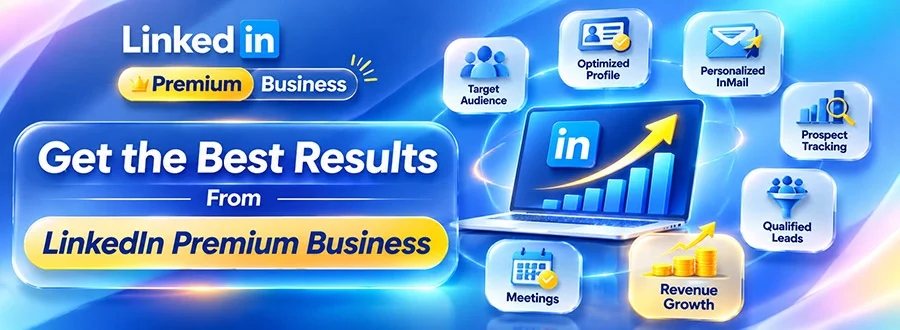
If you decide to purchase the membership, build a clear usage strategy.
10.1 Define Your Target Audience
Identify the type of customer or professional relationship you want to develop.
For example, a website development agency might target founders of small businesses rather than every professional on LinkedIn.
10.2 Optimize Your Profile
Make your profile clear and customer-focused.
Explain your services, experience, and the problems you solve.
Use a professional headline and provide examples of previous work.
10.3 Research Before Sending Messages
Before contacting someone, review their profile and company.
Understand their responsibilities and whether your service is relevant.
This reduces unnecessary outreach.
10.4 Write Personalized InMail Messages
Avoid generic sales pitches.
Mention something relevant about the recipient’s company and explain why your offer may be useful.
A personalized message is more professional than sending the same advertisement to hundreds of people.
10.5 Track Business Conversations
Maintain a spreadsheet containing:
- Prospect name.
- Company.
- Industry.
- Professional position.
- Date contacted.
- Message status.
- Follow-up date.
- Potential business opportunity.
This helps organize your networking activities and measure whether the subscription supports your business goals.
10.6 Measure Actual Results
Track meaningful outcomes instead of simply counting profile views.
For example, measure:
- Relevant professional conversations.
- Qualified prospects discovered.
- Meetings arranged.
- Partnership opportunities.
- New customer inquiries.
- Revenue generated.
These indicators can help you evaluate whether the membership provides practical business value.
11. Is It Worth Paying for This Membership?
The answer depends on how frequently you use LinkedIn for professional growth.
If you regularly research companies, identify decision-makers, contact potential customers, and develop professional relationships, the additional features may be worthwhile.
For someone who rarely uses LinkedIn for business development, the subscription may be unnecessary.
The linkedin premium business price should therefore be evaluated against your expected business value rather than the number of features included.
A consultant who gains one valuable client through professional networking may find the subscription worthwhile.
However, a freelancer who sends generic messages without a clear target audience may receive little benefit.
Similarly, a business owner who already has an effective customer acquisition process may not need the additional tools.
The best approach is to identify a specific problem and determine whether the paid membership solves it.
If you are uncertain, consider an eligible trial before committing to annual billing.
12. Frequently Asked Questions
What is LinkedIn Premium Business used for?
It is designed for business owners and professionals who want additional networking, profile research, company insights, InMail communication, and professional learning resources.
What is the starting monthly price?
LinkedIn’s published US starting price is $69.99 per month. Local prices, taxes, and promotional offers may differ.
Does LinkedIn offer a free trial?
Yes. Eligible members may receive a free trial. Availability and duration vary depending on location and promotional conditions.
Is the subscription suitable for freelancers?
It can be useful for freelancers who regularly research potential clients and develop professional relationships. However, those with limited networking needs may prefer the free account.
How many InMail credits are included?
The official plan includes InMail messaging capabilities. Check the current feature details displayed in your account because allowances and product terms can change.
Can I use it to find customers?
You can use its search, profile, and communication tools to identify potential customers. However, it does not guarantee leads or sales.
Is the Duo subscription worth it?
It may be useful for two business partners or colleagues who both need individual access. Compare the combined cost with the value each person expects to receive.
Can I cancel at any time?
Yes. You can request cancellation at any time through the appropriate subscription management process. For a paid subscription, Premium access generally continues until the end of the billing cycle.
Does cancelling the free trial end Premium immediately?
Yes. LinkedIn states that cancelling a free trial ends Premium access immediately.
Is Premium Business better than Premium Career?
Neither is universally better. Career is designed for job seekers, while Business focuses on professional networking and business growth.
Conclusion
Choosing a professional networking subscription should be based on your business objectives, budget, and expected return.
LinkedIn Premium Business provides additional tools for discovering professionals, researching companies, contacting potential customers, and developing your skills.
Its strongest advantages are advanced profile research, InMail communication, company insights, and LinkedIn Learning access.
However, these tools do not guarantee new customers, successful partnerships, or higher revenue.
My recommendation is to begin with a clear business development strategy. Improve your profile, identify your target audience, and build meaningful professional relationships using the free platform.
If you need additional research and communication capabilities, explore an eligible trial and evaluate the results.
The subscription is most valuable when it supports an existing business strategy rather than replacing one.
Ultimately, your ability to understand customers, communicate effectively, and deliver valuable services will matter more than the subscription itself.